Overview
In modern medical and nursing education, a medical training manikin has become an essential teaching tool. Compared with single-function models, a simulation mannequin can support a wide range of training, including basic nursing care, clinical procedures, emergency techniques, and invasive operations.
So, what skills can learners actually practice on such a medical training model? And how does its multifunctional design provide added value? This article will give you a systematic overview.
What's Medical Training Manikin?
Before explaining what skills can be practiced, let's take a moment to understand what a Medical Training Manikin is.
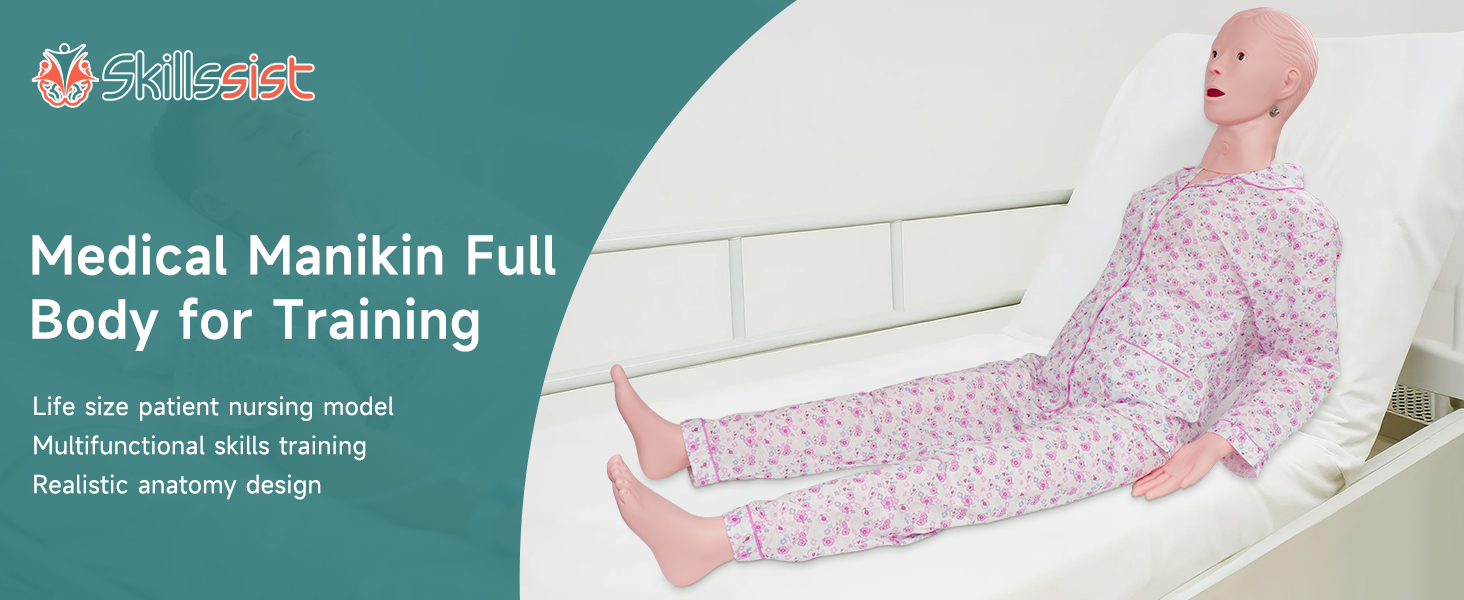
A medical training manikin is sometimes also called a nursing manikin. It is usually a full-body, life-like model that resembles the structure of an adult human body. Its arms and legs are movable, and joints are typically fixed with screws, allowing it to bend, roll, sit up, and perform other common nursing movements.
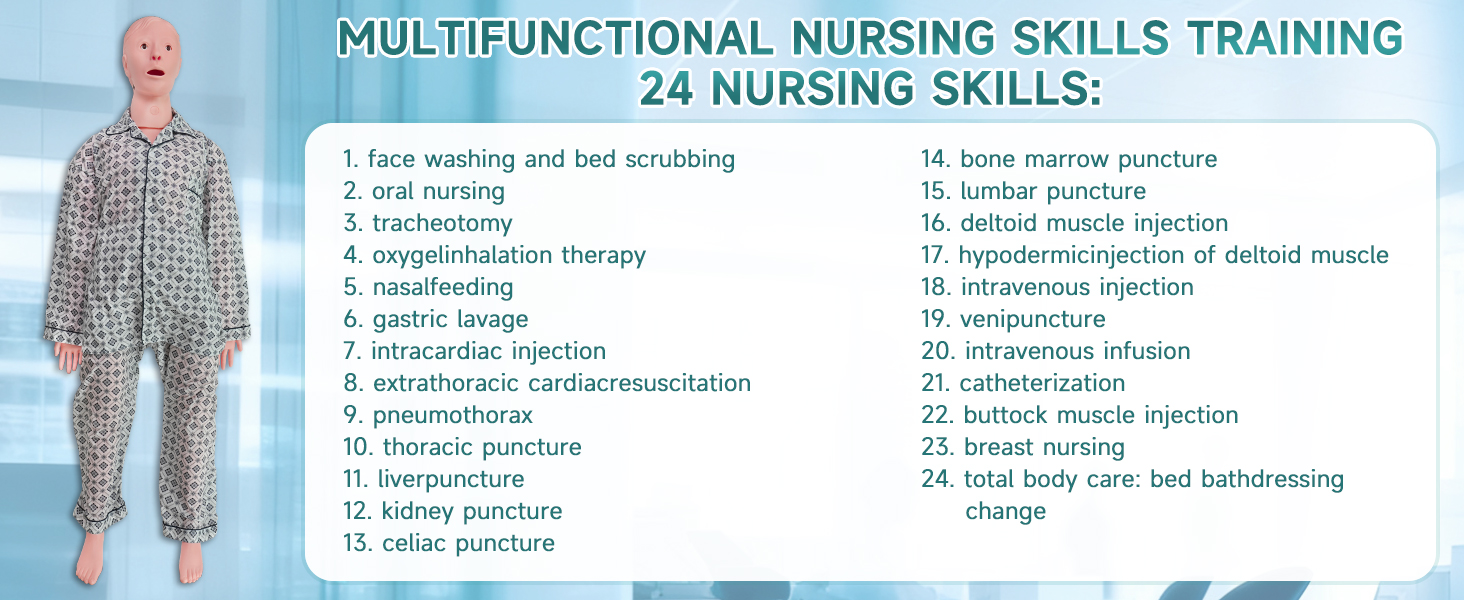
In simple terms, it acts like a reusable teaching “patient.” Most nursing manikins are designed to be multifunctional, supporting over 20 different training activities across areas such as basic care, injection techniques, puncture procedures, and emergency skills. (You can see the full list of supported training functions in the figure below.)
Its core value lies in:
- Allowing students to practice repeatedly in a risk-free environment
- Helping instructors demonstrate procedures in a standardized way
- Improving learners’ hands-on proficiency
- Preparing students for real clinical practice
Because it covers a wide range of functions, a single comprehensive medical training manikin can often be used to teach multiple courses, greatly improving teaching efficiency.
Medical Training Manikin Skills Overview
A medical training manikin is a comprehensive training device that integrates multiple teaching functions. Thanks to its multifunctional design, a single manikin can support training in nursing procedures, clinical techniques, emergency care, and a variety of invasive operations.
To better understand its educational value, the skills that can be practiced on it can be grouped into the following categories:
1. Fundamental Nursing Skills
Fundamental nursing skills are at the core of medical and nursing education. They mainly involve routine patient care procedures, such as:
- Face washing and bed bathing
- Oral care
- Breast care
- Total body care (bed bath, dressing, repositioning)
Although these skills are basic, they are essential in clinical practice. Practicing them on a simulation manikin allows students to become familiar with standard procedures while developing proper technique, professional awareness, and patient-centered care.
2. Airway and Respiratory Management Skills
Airway management is a critical aspect of emergency and critical care. A manikin can be used to practice procedures such as:
- Tracheotomy care
- Oxygen therapy
- Pneumothorax management
- Extrathoracic cardiac resuscitation (CPR)
Through repeated practice, learners can improve their proficiency and response skills in emergency situations.
3. Gastrointestinal Procedures
For gastrointestinal care and emergency treatment, the following procedures can be practiced:
- Nasogastric feeding
- Gastric lavage
These procedures require precise catheter insertion and adherence to strict protocols. Practicing in a simulated environment helps improve accuracy and safety awareness.
4. Injection and Intravenous Therapy Skills
Injection and intravenous procedures are among the most commonly performed clinical skills. A manikin supports training in:
- Deltoid muscle injection
- Subcutaneous injection in the deltoid
- Intramuscular injection in the buttocks
- Intravenous injection
- Venipuncture
- Intravenous infusion
The realistic design of the manikin helps students master proper needle insertion angles, depth control, and technique stability.
5. Puncture and Invasive Procedure Skills
One of the key advantages of a multifunctional medical training manikin is its ability to support training in a variety of advanced puncture techniques, including:
- Thoracic puncture
- Liver puncture
- Kidney puncture
- Abdominal (celiac) puncture
- Bone marrow puncture
- Lumbar puncture
- Intracardiac injection
These are high-risk clinical procedures with limited opportunities for practice in real patients. Simulated training allows learners to build confidence and improve precision in a safe environment.
6. Urinary System Procedures
- Female/Male Catheterization
The urinary and genital modules of a medical training manikin are usually designed to be interchangeable for male and female anatomy, allowing learners to practice both male and female catheterization. This design increases the flexibility and applicability of training, enabling a single manikin to meet the teaching needs for urinary care across different genders.
7. Emergency and Comprehensive Skills Training
A medical training manikin can be used not only for individual skill practice but also for emergency and comprehensive training. Learners can practice procedures such as extrathoracic cardiac resuscitation (CPR), full-body care, emergency workflow drills, nursing competency assessments, and OSCE simulations. This helps develop complete procedural understanding, clinical judgment, and multi-skill integration.
Many upgraded nursing manikins are equipped with interchangeable wound modules, which can be placed on different parts of the body to simulate pressure ulcers, cuts, lacerations, or bleeding wounds. This allows learners to simultaneously practice wound assessment, treatment, dressing changes, and hemorrhage control during emergency or nursing procedures.
By combining scenario-based training with modular functionality, these manikins not only support standardized skill practice but also simulate realistic clinical situations, helping learners enhance practical proficiency and response ability.


What is the Purpose of a Multifunctional Medical Training Manikin?
A multifunctional medical training manikin provides numerous advantages for medical and nursing education:
✔ Covers 24 skills with a single device
✔ Reduces teaching costs
✔ Increases the frequency of hands-on practice
✔ Supports comprehensive skill development
✔ Suitable for nursing schools, medical colleges, and training institutions
As medical education increasingly emphasizes practical skills, multifunctional medical manikins have become an essential tool for improving teaching quality and clinical competency.
Limitations of a Multifunctional Medical Training Manikin
A multifunctional medical training manikin covers a wide range of skills, including nursing, injections, punctures, and emergency procedures. It is ideal for classroom teaching or comprehensive, system-based medical training, helping learners build a foundation in multiple skills and develop overall procedural competence.
However, due to its limited realism, it is less suitable for in-depth practice of a single skill. For example, if learners want a more lifelike experience for injections, punctures, or wound management, they may still need to use specialized high-fidelity training models.
Conclusion
If you are looking for a tool that supports comprehensive medical and nursing training, covering basic care, injections, punctures, emergency procedures, and scenario-based exercises, a multifunctional medical training manikin is the ideal choice.
🛒Explore Skillssist Medical Training Manikins Now→