
In the field of facial injectables, every injection takes place within a subcutaneous space that cannot be directly visualized. Although the entry point on the skin is minimal, the underlying layers contain a complex network of blood vessels and nerves responsible for facial perfusion, sensation, and muscular movement.
Vascular occlusion may lead to tissue ischemia and necrosis, and in severe cases, compromise ocular blood supply. Nerve injury, on the other hand, can result in facial asymmetry or sensory dysfunction. These potential complications make a clear understanding of facial injection danger zones essential in aesthetic medicine training.
These zones are not “forbidden areas,” but regions where anatomical complexity demands higher awareness, structured training, and careful clinical judgment.
The Key Facial Injection Danger Zone
1. Forehead & Glabella: A High-Risk Corridor Connected to the Ocular System
- High-Risk Vessels: Supratrochlear artery, Supraorbital artery
- High-Risk Nerves: Supraorbital nerve, Supratrochlear nerve
The forehead and glabella region is one of the most anatomically sensitive areas in facial aesthetics because it has very thin soft tissue coverage and a dense network of blood vessels and nerves.
In this area, the supraorbital and supratrochlear neurovascular structures travel from deep tissue near the bone and gradually move upward into more superficial layers. This means their depth is not constant, but changes as they ascend above the orbital rim.
This “deep-to-superficial transition” makes it difficult to predict exact anatomical depth during aesthetic procedures.
Clinical Risk Considerations:
The primary reason the forehead and glabella region is considered high-risk lies in its close relationship with both the ocular vascular system and the superficial sensory nerve network.
From a vascular perspective, the supratrochlear and supraorbital arteries are functionally connected to the ophthalmic circulation system. In rare situations, if filler material is inadvertently introduced into an arterial structure under pressure, it may travel retrogradely through interconnected vessels toward the ophthalmic artery. This can potentially compromise retinal blood flow, which is essential for vision.
At the same time, this region also contains important sensory nerves, including the supraorbital and supratrochlear nerves. These nerves are responsible for sensation in the forehead and anterior scalp. If they are irritated, compressed, or mechanically affected, patients may experience sensory disturbances such as numbness, tingling, or localized discomfort.
Although vascular and nerve-related complications are different in nature, they are closely related anatomically due to the dense neurovascular arrangement in this region. This is what makes the forehead and glabella a structurally complex and clinically sensitive area in aesthetic practice.
2. Nasolabial Fold & Alar Base Zone
- High-Risk Vessels: Facial artery, Angular artery, Lateral nasal artery branches
- High-Risk Nerves: Infraorbital nerve, Buccal nerve branches
The nasolabial fold (smile line) and alar base region are among the most frequently treated areas in midface aesthetic procedures. They are strongly affected by age-related volume loss, skin laxity, and soft tissue descent, which makes them common targets for dermal filler correction. Because of this, they are also among the most clinically active zones in facial injection practice.
This region is closely associated with the facial arterial system, often described as the main vascular pathway of the face. The facial artery ascends from the lower face along the lateral aspect of the mouth, gradually progressing toward the nasal region. As it continues upward, it transitions into the angular artery, which supplies blood to the nasal sidewall and nasal base.
One of the most important anatomical characteristics in this region is variability in vessel depth and position. Near the alar base and pyriform aperture, arterial branches tend to lie in deeper planes, closely associated with periosteal or deep structural layers. However, as the vessels travel along the nasolabial fold, they may become more superficial, passing between muscular layers and subcutaneous tissue.
At the same time, the infraorbital nerve exits through the infraorbital foramen and forms a dense sensory network across the midface, providing sensation to the upper lip, nasal sidewall, and alar region.
Clinical Risk Considerations:
The most significant vascular risk in this region is associated with the angular artery, which plays a major role in supplying blood to the nasal ala and nasal tip. If blood flow is compromised in this arterial system, tissue ischemia can develop rapidly due to the limited collateral circulation in certain nasal structures.
In severe cases, vascular occlusion may result in tissue damage, including soft tissue loss or structural changes in the nasal ala. Clinically, this may present as visible asymmetry, skin discoloration, or in extreme situations, tissue necrosis.
In addition to vascular concerns, the infraorbital nerve and its terminal branches are the primary neural structures at risk. These nerves are responsible for sensory innervation of the midface, including the upper lip and nasal sidewall. If they are irritated or compressed—whether due to mechanical trauma or excessive filler volume—patients may experience sensory disturbances such as numbness, tingling, or altered sensation in the midface region.
Although these nerve-related effects are typically less severe than vascular complications, they can still significantly affect facial comfort and basic functional activities such as lip movement and temperature perception.
3. Mandibular Angle & Lateral Midface
- High-Risk Vessels: Accompanying vessels of facial nerve region
- High-Risk Nerve: Facial nerve branches:Temporal branch, Zygomatic branch, Buccal branch, Marginal mandibular branch
The mandibular angle and lateral midface are key areas in jawline contouring and facial lifting procedures. These regions are frequently targeted in aesthetic treatments aimed at improving facial definition and lower face symmetry.
Unlike many other facial areas, this region is closely associated with the facial nerve motor system, which directly controls facial expression rather than sensory perception.
After exiting the parotid gland, the facial nerve divides into multiple branches that spread across the lateral face, forming a relatively consistent but intricate network.
In the lateral midface and mandibular regions—particularly beneath the zygomatic arch and along the mandibular border—these branches tend to travel in more superficial tissue planes. At the same time, this area has limited soft tissue cushioning, with relatively thin fat layers and minimal deep structural protection.
As a result, the facial nerve branches in this region are more exposed compared to deeper or more centrally protected facial structures, increasing their vulnerability during aesthetic procedures.
Clinical Risk Considerations:
The most important risk in this region is injury to the facial nerve motor branches, which control movement of the lower and midface.
If the buccal branch or marginal mandibular branch is affected—either through mechanical trauma, excessive pressure, or unintended tissue disruption—the corresponding facial muscles may lose normal motor control. Clinically, this may present as:
- Asymmetry of the mouth corner
- Reduced lip control
- Drooling or impaired oral competence
- Difficulty achieving symmetrical smiling
In more significant cases, patients may show partial facial movement impairment resembling facial paralysis. While mild nerve injuries may recover gradually over time due to neural regeneration, more severe mechanical injuries can lead to prolonged functional limitation and noticeable facial asymmetry.
Beyond physical effects, such outcomes may also have a substantial psychological impact on patients due to changes in facial expression and social appearance.
Conclusion: Invisible Blind Spots Require Visible Precision Training
Studying flat anatomical diagrams can build foundational knowledge, but it cannot fully replace the real sense of tissue depth, resistance, and layer transitions experienced during injection practice. Without a three-dimensional understanding of facial anatomy, injections can easily become a process of estimation rather than precision.
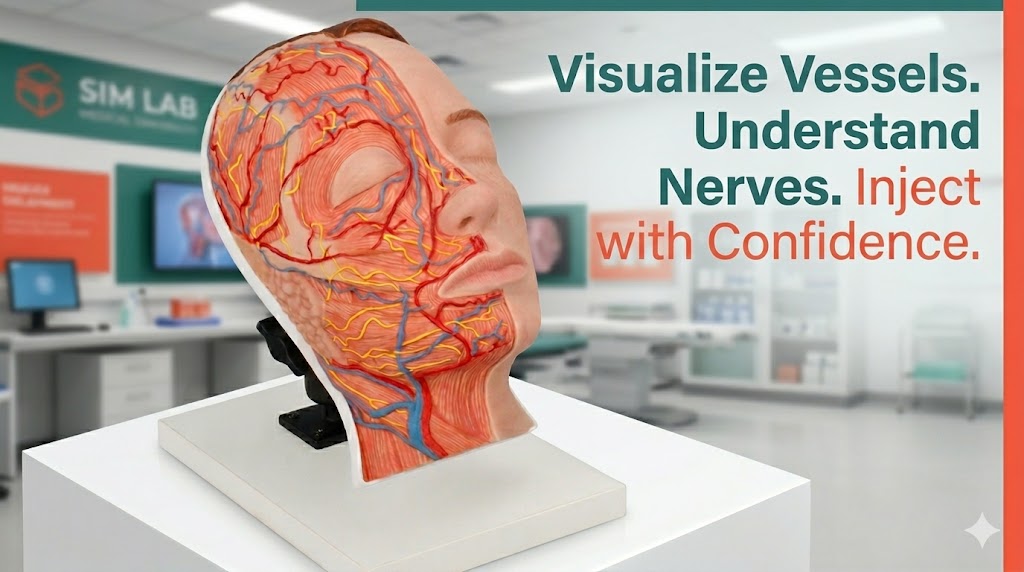
To help bridge this gap, Skillssist facial injection models are designed to make invisible anatomy visible and trainable. They allow learners to better understand the relationship between skin layers, fat, muscle, and deeper structures such as vessels and nerves in a structured way.
In particular, Half-anatomy Facial Injection Mannequin Head Model—combining realistic skin simulation with exposed internal structures—help users connect visual anatomy with tactile feedback. This significantly improves spatial awareness and procedural confidence before working on real patients.
Ultimately, safe and precise injection skills are built not only through theory, but through repeated hands-on training that transforms anatomical knowledge into practical experience.