
Both tracheostomy and cricothyrotomy create an airway through the front of the neck, but they enter at different anatomical locations and usually serve different clinical purposes.
The main difference is that a cricothyrotomy creates an opening through the cricothyroid membrane, typically for emergency airway rescue, while a tracheostomy creates an opening lower down, directly into the trachea, often for ongoing airway support. Understanding these differences helps medical students, nursing students, and emergency care trainees connect airway anatomy with clinical practice.
This guide compares tracheostomy vs cricothyrotomy in terms of location, indications, emergency use, and follow-up care. It focuses primarily on adult surgical airway management; pediatric approaches require separate consideration.
Tracheostomy vs Cricothyrotomy at a Glance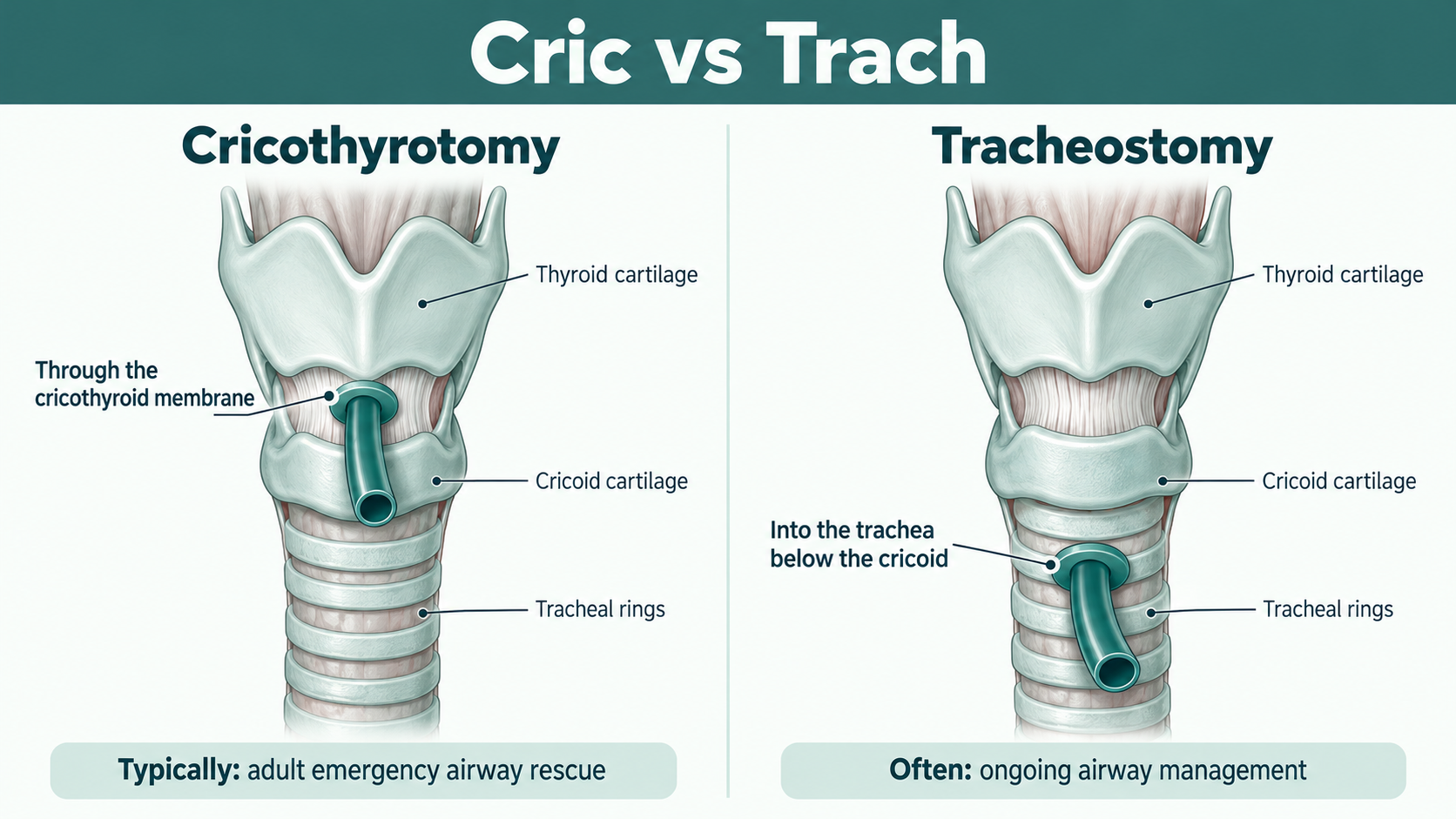
| Feature | Tracheostomy | Cricothyrotomy |
| Opening location | Anterior trachea, below the cricoid cartilage | Cricothyroid membrane, between the thyroid and cricoid cartilages |
| Typical purpose | Ongoing airway management or relief of certain airway obstructions | Emergency airway rescue when other approaches cannot maintain oxygenation |
| Common setting | ICU or operating room; may also be performed in emergencies | Emergency airway situations |
| Anatomical access | Usually involves deeper tissue access | Generally offers more superficial access |
| Duration | May be temporary or long term | Commonly established for immediate rescue, with subsequent airway management reassessed |
| Follow-up focus | Tube patency, humidification, secretion management, and stoma care | Airway confirmation, stabilization, monitoring, and evaluation of continuing airway needs |
These are typical distinctions rather than absolute rules. Patient anatomy, the underlying problem, available expertise, and the urgency of the situation all affect clinical decisions.
What Is a Tracheostomy?
A tracheostomy is a surgically created opening through the neck into the trachea, or windpipe. A tracheostomy tube is usually placed through this opening to maintain an airway.
Common tracheostomy indications include prolonged mechanical ventilation and airway obstruction associated with certain head and neck conditions. The procedure may be planned, but it can also be required urgently.
A tracheostomy is not necessarily permanent. Some patients need it temporarily while their condition improves, whereas others require longer-term support. Its duration depends on the underlying disease and whether the patient can safely breathe and protect the airway without the tube.
What Is a Cricothyrotomy?
A cricothyrotomy establishes an airway through the cricothyroid membrane, the tissue between the thyroid cartilage and the cricoid cartilage.
It is primarily associated with emergency airway rescue. A key situation is “cannot intubate, cannot oxygenate,” or CICO, in which attempts to establish an airway through other methods have failed to maintain adequate oxygenation.
The term cricothyroidotomy describes the same procedure. Therefore, someone searching for “cricothyroidotomy vs tracheostomy” is asking essentially the same comparison.
Cricothyrotomy may involve a surgical technique or a needle-based technique. These approaches differ in equipment and their ability to provide ventilation, so the terms should not be treated as technically interchangeable.
Where Are the Openings Located?
The anatomical location is the clearest difference between tracheostomy and cricothyrotomy.
Cricothyrotomy Location
The cricothyroid membrane lies between two laryngeal structures:
- Thyroid cartilage: the larger cartilage above, which forms the prominence commonly called the Adam’s apple.
- Cricoid cartilage: the ring-shaped cartilage below.
A cricothyrotomy passes through the membrane between them.
Tracheostomy Location
A tracheostomy enters the trachea below the cricoid cartilage. The opening is commonly made around the second and third tracheal rings, although the exact site depends on the technique and patient anatomy.
The important distinction is the structure entered: cricothyrotomy passes through the cricothyroid membrane; tracheostomy enters the trachea below the larynx. Simply describing both as “a hole in the neck” misses this difference.
When Is Each Procedure Used?
Although both procedures provide access to the airway, their typical clinical roles differ.
Cricothyrotomy: Emergency Airway Rescue
Cricothyrotomy is generally considered when an adult urgently needs an airway and other methods cannot provide adequate oxygenation.
Severe upper-airway obstruction, major facial trauma, or swelling may contribute to such a situation. However, these conditions do not automatically require cricothyrotomy. The decisive issue is whether an effective airway and adequate oxygenation can be maintained.
Tracheostomy: Ongoing Airway Management
Tracheostomy is commonly used when a patient needs continuing airway support, such as prolonged mechanical ventilation or management of certain obstructive conditions.
It can also serve as an emergency airway in selected circumstances. Describing tracheostomy as “always elective” would therefore be inaccurate. Emergency airway selection depends on the patient and the expertise available.
Why Is Cricothyrotomy Often Preferred in Adult Airway Emergencies?
When oxygenation cannot be maintained, the time required to establish an airway matters.
The cricothyroid membrane provides relatively superficial access. In comparison, a tracheostomy generally requires access through more tissue and consideration of structures such as the thyroid isthmus and nearby vessels.
These anatomical differences help explain why surgical cricothyrotomy is commonly preferred for adult emergency airway rescue. However, it remains a demanding procedure, particularly when landmarks are difficult to identify.
The choice is not based on speed alone. Neck anatomy, injury patterns, clinician experience, and the clinical setting can alter the approach.
Risks and Follow-Up Care
Both procedures carry risks, including bleeding, incorrect tube placement, injury to surrounding structures, and later airway narrowing.
It is misleading to label one procedure universally safer. Comparing an emergency rescue procedure with a planned procedure involves different patients and circumstances. A systematic review of emergency surgical airways found broadly comparable complication rates, while noting the importance of patient characteristics and clinician experience.
After either procedure, clinical priorities include maintaining a patent airway, assessing oxygenation and ventilation, securing the tube, and monitoring for complications.
For ongoing tracheostomy care, attention also includes humidification, secretion management, suctioning when indicated, and care of the surrounding skin and stoma. Specific care requirements depend on the tube, patient, and local clinical protocol.
Does a Cricothyrotomy Always Need Conversion to a Tracheostomy?
An emergency cricothyrotomy does not automatically require conversion to a tracheostomy in every patient.
Traditional teaching often recommended conversion because of concern about subglottic stenosis. However, a 2022 systematic review and meta-analysis did not find evidence supporting routine conversion.
The authors also emphasized an important limitation: their findings should not be generalized to patients requiring prolonged or permanent airway cannulation.
The practical takeaway is that conversion requires individual assessment. Ongoing airway needs and the benefits and risks of another procedure matter more than a fixed timetable applied to every patient.
Learning the Differences Through Simulation
For students, understanding the anatomy is the starting point. Simulation then helps connect that knowledge with the skills required for different clinical roles.
Cricothyrotomy training may focus on identifying anatomical landmarks, preparing appropriate equipment, and practicing emergency airway skills under supervision.
Tracheostomy care training may focus on tube and stoma assessment, dressing changes, inner cannula care where applicable, and suctioning practice.
The training model should match the learning objective. A simulator designed for caring for an existing tracheostomy may not support incision or surgical airway placement. Educators should check its listed functions before selecting it for a course.
Conclusion
Whether you are studying for an exam, preparing for a clinical placement, or planning a training session, understanding tracheostomy vs cricothyrotomy means connecting what you learn with the situations you may encounter.
Use this comparison as a starting point for questions, discussion, and supervised practice. Focus on the knowledge and skills relevant to your role, with guidance from your instructors and the protocols used in your clinical setting.